

What is TOPA?
The “Tenant Opportunity” Opportunity Act (TOPA) is a policy being considered by council members. TOPA takes advantage of the housing crisis to falsely promise homeownership to tenants. Careful reading and analysis of the legislation reveal TOPA benefits special interests at the expense of both tenants and homeowners. TOPA would take affordable housing funds meant for tenants and divert it toward bureaucracy and developers. The TOPA developers would then take this money and target local residents to acquire rent-controlled buildings for below market price and drastically raise rent on tenants.

Where would affordable housing money go under TOPA and would there be any accountability?

TOPA is a bait and switch scheme. Most tenants are not in a position to purchase homes. The TOPA legislation is being pushed by special interests and housing developers cloaking themselves as “non-profits”. They are an unaccountable bureaucracy with staff compensation packages and seek at least $10-15 million each and every year in public funding. Many use appealing names like Housing Land Trusts, Qualified Organizations, and even call themselves “Tenant Organizations” to siphon affordable housing funds. Regardless of the name being used, they target public money while exempting themselves from financial accountability and standard requirements. Besides exempting themselves from local rent control laws, their lawyers wrote TOPA to exempt them from the requirement to demonstrate financial capacity to purchase as well as the requirement to demonstrate financial sustainability over time. Many residents are concerned that the Northern California Land Trust (NCLT) is lobbying for $10-15 million in public funding even though it has a history of financial mismanagement and bankruptcy. Responsible housing legislation and funding should come with built-in financial requirements. Otherwise, taxpayers would be on the hook for millions without tangible results. Ask your council members to require financial accountability and annual performance metrics written into proposed legislations.
Would TOPA lower property value and destroy the home equity that seniors need for retirement?
Yes. TOPA would drastically drop property value.
-
TOPA is extremely bureaucratic, requiring extended time delays and deed restrictions. Properties in cities with TOPA restrictions would be worth much less compared to those in cities without TOPA restrictions. Value could easily drop by hundreds of thousands of dollars. Many seniors who put their life savings into their home for retirement will be significantly harmed. Destroying property value will also drop property tax revenue which the city relies on to provide crucial services like fire prevention and public safety.


Would TOPA prevent me from transferring my property to my family?
Yes.
-
TOPA would prohibit transfers between certain family members and dictate who is considered a part of your family and who is not. TOPA transfer restrictions would particularly impact the LGBTQ community and non-Eurocentric family structures. TOPA would prevent black homeowners from keeping properties in black hands. TOPA requirements would block the transfer of your own home to your best friend or to anyone you choose.

Are there exemptions from TOPA restrictions for emergency situations?
There are no exemptions in TOPA for emergency situations such as financial hardships.
-
The bureaucratic time delays under TOPA would literally impede a property sale for hundreds of days or even indefinitely.
TOPA’s extended time delays could cause deaths in case of medical emergencies. After public outcry, TOPA lawyers drafted limited and dubious exemptions for health emergencies. TOPA would expose residents to expensive legal costs and hefty fines. This flawed proposal would intrude into extremely personal family affairs of private citizens.

What properties would be ensnarled by TOPA?
TOPA would ensnarl properties owned by local residents. TOPA would especially target property owners in predominantly poor and minority zip codes. For example, TOPA would disproportionally impact minority-owned properties in historically segregated areas in South and West Berkeley.
The local TOPA proposal would impact all property types, including single family homes.
-
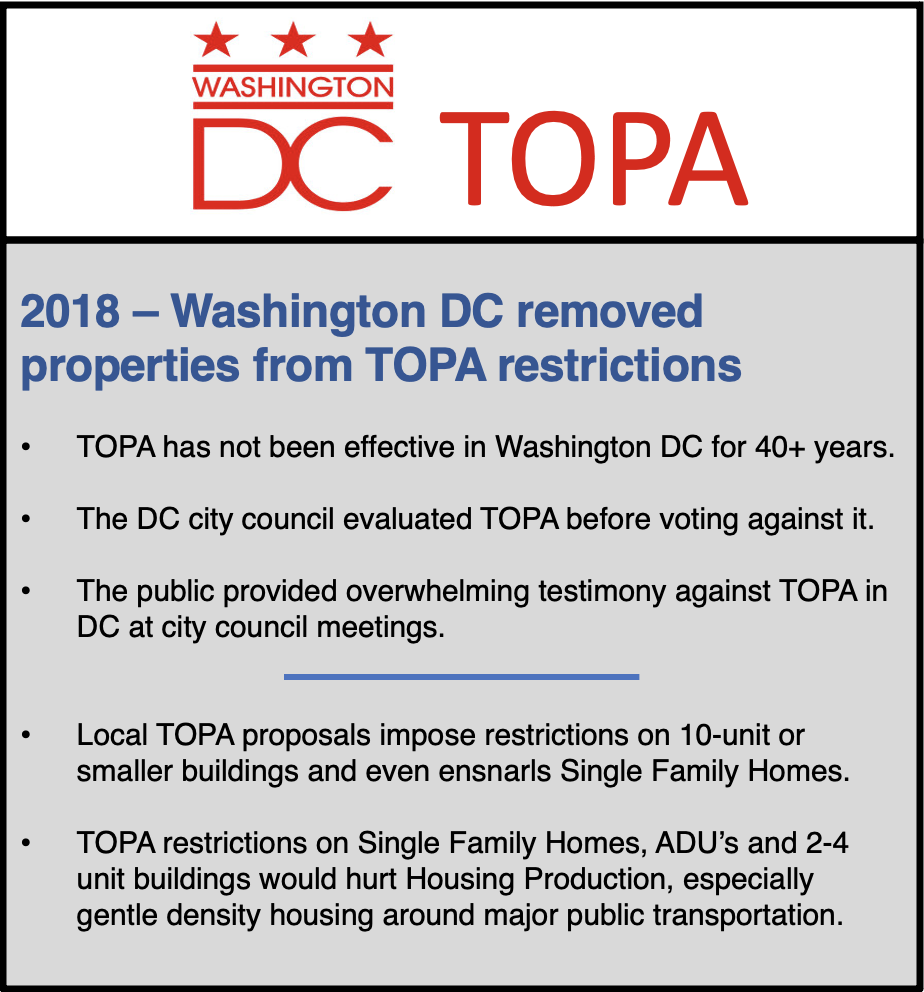
After 40+ years experience with TOPA, Washington DC defunded TOPA and removed properties from TOPA restrictions, including single family homes, condos, and single unit townhomes. DC’s experience suggest larger 40+ unit buildings pencil out better due to economy of scale. Existing local Small Sites Housing Programs can help with affordable housing and can acquire larger buildings without TOPA’s bureaucracy or its many harmful effects.
Can I market my rental property for sale before complying with TOPA?
-
No. TOPA would prevent local residents from selling to certain family members or friends and require them to first offer their property to tenants or TOPA developers. Since most tenants are not in a financial position to purchase, the TOPA law is intentionally designed to benefit TOPA developers, their staff compensation packages and their associates.
Would owners receive any monetary benefit for participating?
-
TOPA would strip affordable housing money from tenants and life savings from local residents. TOPA developers say TOPA would provide “participants” a benefit by allowing for a refund in a portion of the real property transfer tax. A few thousands in transfer tax does not compensate for TOPA taking hundreds of thousands and life savings from hard-working, local residents. A truly beneficial program would be completely voluntary and not forced on unwilling residents.
Would TOPA allow a fair market value for my property?

The only way to get a fair market value for a property is to actually list it on the open market. TOPA’s extremely convoluted process would prevent residents from freely listing their property on the open market, forcing residents to sell for much less to TOPA developers. Initial TOPA proposals dubiously tried to bypass Fair Market Value by allowing a city-trained appraiser to dictate the sales price. Alarmed local residents and councilmembers forced TOPA lawyers to remove the appraisal provision from TOPA proposals.
How long would it take me to sell my property under TOPA? How were these timelines determined?
-
TOPA is purposefully convoluted policy with extended time delays lasting hundreds of days or even indefinitely. Multiple TOPA developers can each take a turn implementing the delay tactic. The punitive timeframes is intended to hold local residents who need to sell hostage. The delay would force people to sell for less and cause significant harm to long-time residents, particularly minority homeowners.
TOPA developers purposely delay sales by making the excuse that tenants need time to figure out financing. In fact, TOPA would not secure financing for tenants and would instead siphon funding that could help tenants purchase such as direct down payment assistance. The TOPA scheme is a False Promise of homeownership to tenants and would benefit special interest developers who seek to acquire property below market price through delay tactics and deed restrictions.
Would 1031 exchanges be affected by TOPA delays?
The extended time delays imposed by TOPA would not work for 1031 exchanges.
-
The lengthy TOPA timeframes would also adversely impact all residents hoping to purchase. For examples parents needing to purchase before school starts would not be able to wait around or cope with TOPA’s uncertain time frames. First time buyers would experience more difficulty getting a mortgage and interest locks would expire during the onerous delays. Fewer residents would have access to homeownership under TOPA. TOPA developers would cause delays and would be prioritized over local residents in purchasing homes.


Tell city council members you strongly oppose TOPA and its many harmful effects.